
Charlotte Weitze
There is scratching and whistling at the door. What is it that wants to come in? Perhaps the reality we have shut out.
Charlotte Weitze’s kaleidoscopic, monstrous full-moon novel Ulvemælk (“Wolfmilk”) abolishes all categorical hierarchies and inscribes itself in the finest tradition of Nordic storytelling. Adventure, folklore, the fantastic, and visions of a future reality all find their way into Weitze’s utopian realism. Here, the contemporary is not merely the present day, for both the past and the future lie just around the corner. “Time was elastic,” as the novel puts it. Weitze invites us to see the world in all its enigma, full of wonder – and reminds us how easily we can destroy it for ourselves.
Ulvemælk branches into three strands. In two of them, we follow the Danish folklorist Evald Tang Kristensen, who lived from 1843 to 1929. In doing so, the novel dons the mantle of exofiction. Here, Weitze employs a double strategy: exofiction tends to give voice to those who have been forgotten, or who have long stood in the shadows – to bring historically situated individuals to life through narrative. This is what Weitze does with Evald Tang Kristensen, while he himself (for whom it is a matter of life or death) seeks to cast light on a world of ideas that, by the early twentieth century, is almost extinct. Tang Kristensen is an explorer in search of human recollections; the collective memory. He faithfully traverses the Jutland heath in order to gather oral tales and absorb them before it is too late and they vanish. He is particularly intent on obtaining the ending of the story of the maiden and the she-wolf. An animal leaves traces of its paws, while a human leaves traces of their words. Weitze has the scent of both.
In the novel, we also meet the writer Inga, who can no longer write stories anyone wants to read, and her beloved Alexander, who researches wolves. The year is 2040. They have moved to Jutland, now planted with forest. Nothing is untouched, neither nature nor humanity. Weitze has an exceptional eye for the short-circuiting of human logic. While on the one hand we may fear nature’s wild, uncontrollable incursions – such as the wolves, which carry within them the potential for devastation and death – the Danish population of 2040 has at the same time admitted another invasive force. Artificial Intelligence, known as OS, now exists side by side with humanity. It hears everything, monitors everything. The algorithm is a ghost that we have allowed to feed from our own hand without blinking, and whose instrumental and reproductive, suffocating grip makes everything go black before Inga’s eyes.
Ulvemælk is a dizzying and generous literary achievement. An all-encompassing novel about transformation, longing, nature, the place of the enigmatic in our reality, and the loss of existential meaning.
The book lends us the night-yellow eyes of nature’s spirits and asks us: What do we do now, if we have the opportunity to rewrite the world? Herein lies the novel’s power of resistance and transformation. Perhaps we can become better at letting in what is standing there, scratching at our door.
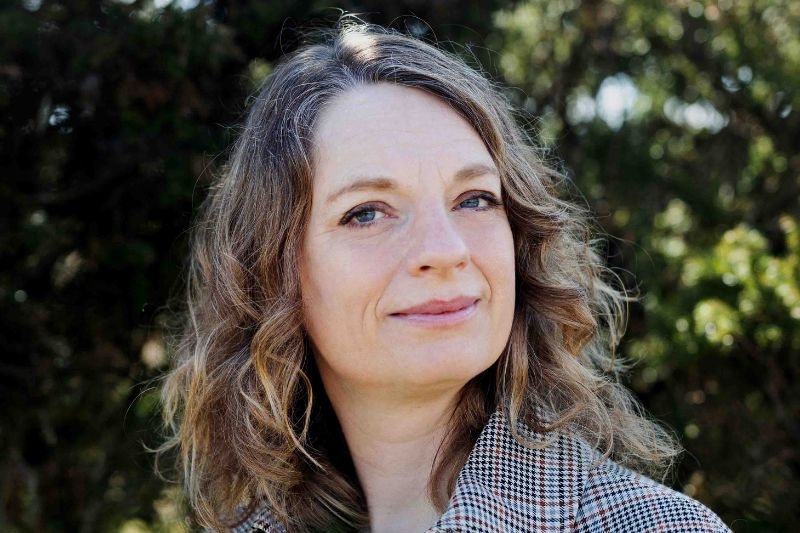
Charlotte Weitze (b. 1974) has always followed her own, original path in Danish literature. She made her debut in 1996 with the collection of short stories Skifting for which she won Bogforum’s Debutantpris. She holds an MA in folkloristics and has written short stories, novels, and radio plays, as well as the essay Klimaet og kunstneren (2022). Since her debut, she’s been concerned with creating space for a re-enchantment of the world and of nature, most recently in her two critically acclaimed novels Rosarium in 2021 and now in the novel Ulvemælk. In 2025, she received the Danish Arts Foundation’s lifetime honorary award, which is granted to artists who have “made a decisive impact through their artistic practice.”