Nordic ministers for trade and industry strengthen co-operation on space policy
As a means to concretise this, the ministers will establish a Nordic roundtable on space-related issues. This forum will serve as a platform for the exchange of information, discussion, and new co-operation initiatives. In the declaration, the ministers emphasise that deepened co-operation on space activities is crucial in light of the changing security policy landscape.
In recent years, a vibrant and strong community of space companies has emerged in the Nordic Region. Together with traditional space organisations, the Nordics now boast a robust space ecosystem. Co-operation between the Nordic countries will strengthen the region’s competitiveness, security, and our joint space efforts within the EU.
Societies are becoming increasingly dependent on space technology. That’s why it’s important for the Nordics to take a position and together develop their own competencies in this field.
Shared interests and European influence
The Nordic countries already co-operate through the European Space Agency (ESA) and the EU’s space programme. In addition, the ministers see potential for increased co-operation within the defence industry. They observe that the Nordic countries share many interests in the development of Europe’s space infrastructure. A stronger Nordic voice in European forums can promote innovation, support businesses, and ensure that the Nordic Region actively contributes to Europe’s independent access to space.
“This declaration marks a new beginning for Nordic space dialogue, with aspirations to strengthen both the region’s technological capacity and its role in the European and global space sector,” says Karen Ellemann, Secretary General of the Nordic Council of Ministers.
Space technology is important for our societies
Satellite-based services support everything from transport and energy to climate monitoring and digital communication. This is particularly important in the Arctic region, where space technology can play a key role in climate monitoring. Closer co-operation may help to save resources, increase competitiveness, and improve economic growth. By developing similar technical solutions, the Nordic countries can make co-operation smoother and more efficient.
We, the Nordic ministers for trade and industry, reaffirm our commitment to strengthening Nordic dialogue on space issues. Deeper co-operation enhances our competitiveness and contributes to our regional development, which is necessary in light of the changing security policy landscape.
We note that the Nordic countries are already working together to develop space infrastructure, primarily by way of activities within the European Space Agency (ESA) and the EU’s space programmes. In addition, there is the potential for increased co-operation on space issues within the defence industry.
Information and services established by way of space activities support infrastructure across various sectors of society. A variety of existing societal functions can be improved and streamlined by way of space-based services, and entirely new applications can be introduced. As society becomes increasingly digitalised, Earth observation, time and positioning data, and ubiquitous communication links become essential building blocks for the development of applications. Satellite-based services are also an important tool for the development of the Arctic region, including the monitoring of climate change.
As many critical components of infrastructure and societal functions are already largely dependent on space services, it’s vital to ensure the continuity of these services even under exceptional circumstances and disruptions.
We note that the Nordic countries share many common interests regarding the development of Europe’s space infrastructure and the use of available data and services in our societies. We recognise that regular dialogue between our countries can benefit the Nordics by giving them a stronger voice in European forums, supporting businesses in developing new innovations, and promoting the development of various functions within our societies.
We are stepping up our aspirations to contribute to Europe’s independent space capacity, such as access to space, and the construction and operation of satellites.
We are resolute that closer co-operation and dialogue can save resources, foster innovation and competitiveness within our space industries, and contribute to our economic growth. Similar technical solutions in the Nordic countries would make functional co-operation smoother and more efficient.
Consequently, we commit to deepening Nordic dialogue on space issues by organising a Nordic roundtable discussion on space affairs. This forum shall serve as a framework for the exchange of information, discussion, and initiatives for further co-operation within the space sector. Discussions surrounding the details and specific forms of co-operation will continue in the Nordic committee of senior officials for business policy.
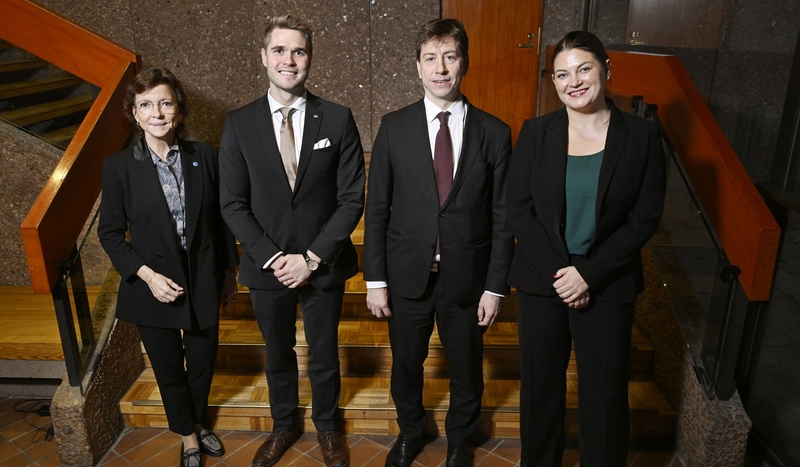
Sakari Puisto, Finland
Jesper Josefsson, Åland
Ebba Busch, Sweden
Logi Einarsson, Iceland
Cecilie Myrseth, Norway
Morten Bødskov, Denmark
Christina Egelund, Denmark
Margit Stórá, Faroe Islands