
Madame Nielsen
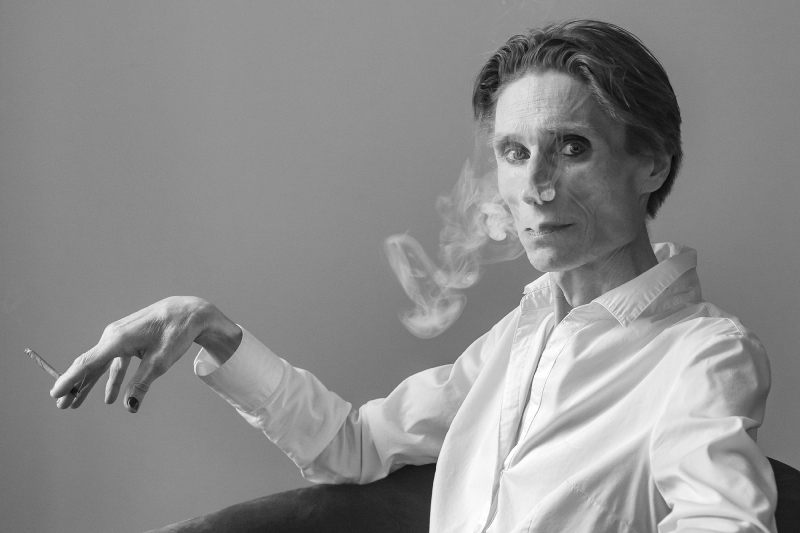
One might be tempted to call the author of Dødebogsblade ('Pages of the Book of the Dead', not translated into English) a literary chameleon. But while the animal changes to adapt to its surroundings and external circumstances, Madame Nielsen’s transformative ability is driven by an inner necessity – an unpredictable, deeply original, and never adaptable transformation, fuelled by a hunger to expose herself to the world. A necessity to find a way out of oneself, so as not to become trapped within oneself. A constant exploration – not of becoming, but of what is possible.
The book consists of excerpts from the author’s diaries from 2009, 2013, and 2016, written during temporary stays in Rome, Paris, and the Scottish countryside south of Edinburgh. The diary form, with its aimless, experimental, and unfiltered approach, serves as a method. “There is no truth. There is only practice (…) you are what you do,” writes Madame in her diary. Later, she adds: “I try to break myself apart,” as she wanders out of the text’s structured pathways and weaves the world into her writing, her language.
In the diary entries in Dødebogsblade, something larger is at stake than the specific and personal. It’s an attempt to exist by placing oneself in language, outside of “oneself”, beyond categories—to abolish them altogether: “.... while I wrote all this, I was gone, out of the world, replaced by meaning.”
In the cities, the author wanders endlessly, never finding a moment’s peace, following a principle of homelessness and disorientation. “What am I doing here?” – the title of nomadic writer Bruce Chatwin’s 1988 book – echoes through Dødebogsblade. The only things keeping her rooted are The Boy, The Girl, and The Woman.
Dødebogsblade is also a beautiful love story for those closest to her. When Madame Nielsen, like another August Strindberg in Inferno, leaves her beloved and her children behind to write in Paris, she is desperate, restless: “It’s unbearable that language should be the only place where I can truly live and surrender myself,” she writes. But her courage to exist within this wandering, unbearable state is precisely what elevates Dødebogsblade to great literature.
It’s in Paris that she finally pauses her dizzying hunger for movement, for floating – both spiritually and physically – and transforms yet again. Here, she puts on a dress, applies discreet makeup, and steps outside for the first time as a heron-like female being. In this brilliantly orchestrated passage, she undermines conventional ways of thinking – not only about life but also about the diary genre itself – demonstrating how she positions herself in her own unique literary space. “Now I’m almost no one, a female being. At any moment, I can become someone else, fragile and floating,” she writes. Who knows if next time Denmark’s great literary shapeshifter will transform into an animal – perhaps a heron or a beetle. For Madame Nielsen, everything is possible.
Madame Nielsen debuted in 1997 under her birth name, Claus Beck-Nielsen. However, in 2001, she declared herself dead and later staged her own funeral in 2010. Since then, the author has published books under various names: Das Beckwerk, Helge Bille, Nielsen, as anonymous, and, for the first time in 2014, as Madame Nielsen. The distinction between autobiography and fiction is dissolved in her transformative writing practice. This principle of dissolution is also manifest in Dødebogsblade, which stands as a high point in her body of work.