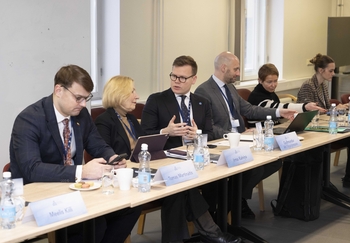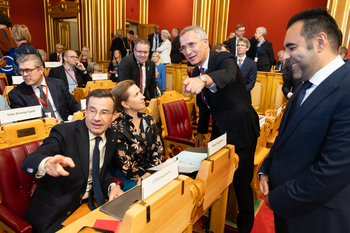
Ministers discuss future of St. Petersburg office
It is clear from these negotiations that the decision to list the Nordic Council of Ministers’ office in St. Petersburg as a foreign agent is not going to be reversed. As things stand, there is little point in continuing discussions.
Over the past few weeks, the Council of Ministers’ Secretariat in Copenhagen has conducted a detailed impact assessment of various options.
“The situation is unfortunate,” says Secretary General Dagfinn Høybråten. “We did everything we could using diplomatic channels, but failed to achieve the result we had hoped for. We now have to consider the impact on the Council of Ministers’ future activities in northwest Russia.”
The Russian Ministry of Justice changed the status of the Council of Ministers’ St. Petersburg office to “foreign agent” in January. Under Russian law, foreign-funded NGOs involved in political activities must be listed as foreign agents.
The Council of Ministers and the Nordic countries have protested against this decision, arguing that the office’s activities are not political. The Council of Ministers has also stressed that its co-operation with the Russian authorities at both national and local levels has always been excellent, and that the office complies with the law in all its activities. The categorisation of the Council of Ministers’ activities in Russia as NGO activities – making it subject to this legislation – is, it feels, unfortunate and should be reconsidered.
“Everyone’s primary concern is that it is not fitting for the five Nordic governments to pursue activities considered as those of a ‘foreign agent’ in Russia,” Høybråten says. It goes against all of the fundamental principles of the Council of Ministers’ work in the country.”
In the wake of the decision, the Council of Ministers has significantly scaled back its operations in Russia until further notice.