Nordic summit: Unity is strong, but must be protected
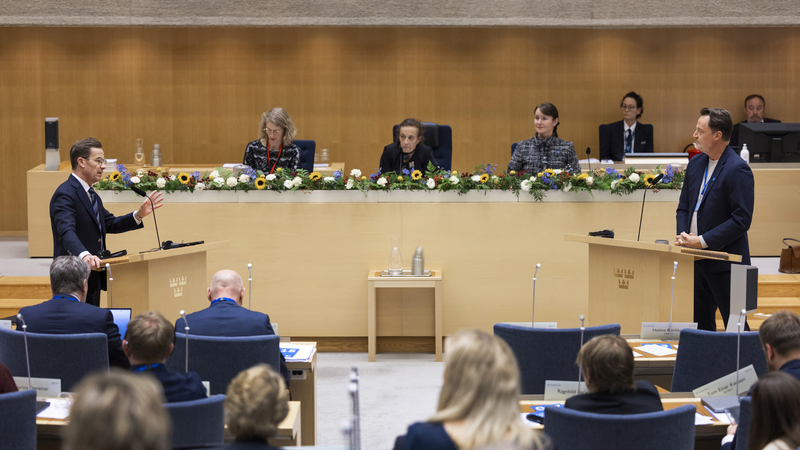
Sweden’s Prime Minister Ulf Kristersson was questioned by Johan Dahl, member of the Faroese parliament and of the Nordic Council.
This year’s theme – “Nordic cohesion and everyday value in troubled times” – set the tone for the summit as the Nordic Council and the Nordic prime ministers gathered in in Sweden’s Riksdag for the largest annual Nordic forum for political co-operation.
The summit at the Session of the Nordic Council once again demonstrated how Nordic parliamentarians can engage in open dialogue with government leaders and discuss shared challenges across party lines and national borders – a clear expression of the strength of Nordic democracy.
“Without doubt, this is the most important arena for Nordic political and parliamentary discussion It’s a unique platform that must be safeguarded and whose profile should continue to be strengthened,” said Ville Väyrynen, chair of the Finnish delegation to the Nordic Council.
This is a unique platform that must be safeguarded and whose profile should continue to be strengthened.
A community with many voices
The Nordic prime ministers highlighted the value of the strong Nordic community, and the importance of defending our societies and strengthening the region’s resilience. Although co-operation is close and wide-ranging, it must also be protected.
“Our countries have built some of the very best societies in the world to live in. We’re certainly not flawless, but every day we strive to do more right than wrong. But we also know that none of our strengths can be taken for granted – what is good must be nurtured and defended,” said Sweden’s Prime Minister Ulf Kristersson in his speech.
In his address, Faroese Prime Minister Aksel V. Johannesen emphasised that the issue isn’t only co-operation, but also recognising one another. He stressed the significance of the Nordic Council prizes, two of which have been awarded to the Faroe Islands this year.
“When a small language is heard, the whole Nordic Region benefits. The Nordic Region is a landscape of many voices,” Johannesen reminded the audience.
Our countries have built some of the very best societies in the world to live in. But we also know that none of our strengths can be taken for granted – what is good must be nurtured and defended.
Well-being and security high on the agenda
The meeting was shaped by the ongoing security policy developments and pan-Nordic support for Ukraine, but also by the domestic political situation in several Nordic countries.
Parliamentarians underlined the importance of delivering concrete results for citizens and raised shared challenges such as youth crime, cross-border criminality, budget cuts, the climate crisis, and the growing vulnerability of our societies.
“Security is a major concern for us in the Nordic countries. This is an excellent moment to update the Helsinki Treaty. Even though the Nordic Council of Ministers has no mandate in the matter yet, this is a key element in the Nordic Region’s future – how we can live safely in the world we find ourselves in,” said Ville Väyrynen, chair of the Finnish delegation.
Security is a big concern for us in the Nordic countries, namely how we can live safely in the environment we find ourselves in.
“The Nordic Region consists of eight countries”
Although the Nordic Region speaks with a stronger voice than it has for a long time, the discussion also touched on the status of the Faroe Islands, Greenland, and Åland within Nordic co-operation. Denmark’s Prime Minister was asked by former President of the Nordic Council Bryndís Haraldsdóttir, about how work on updating the Helsinki Treaty is progressing, and how she views the absence of Greenland’s head of government from the summit.
“In my view, the Nordic Region consists of eight countries. The Danish government supports Greenland’s and the Faroe Islands’ wish to participate in Nordic co-operation on equal terms with the other countries,” replied Mette Frederiksen.
At the 2024 Session of the Nordic Council in Reykjavik, the Nordic Council unanimously decided to recommend that the Nordic governments update the Helsinki Treaty to fully include Greenland, the Faroe Islands, and Åland in Nordic co-operation on the same terms as the other Nordic countries.
“The goal for everyone is unity. We want all eight countries to be part of this co-operation – it’s very important,” said Ville Väyrynen, chair of the Finnish delegation, which will hold the Presidency of the Nordic Council in 2026.
You can read more about the work to update the Helsinki Treaty here: