
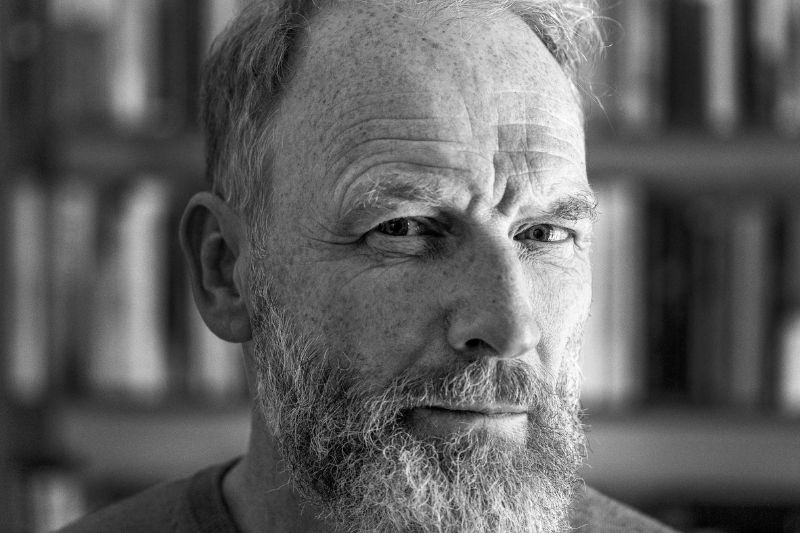
Jón Kalman Stefánsson
In the autumn of 1615, the so-called Spanish Killings were committed in Iceland – a brutal massacre in which Icelandic farmers and fishermen attacked and killed a group of shipwrecked Basque whalers at the instigation of the district sheriff of Ísafjörður. Much about what happened remains unclear. For a long time, the principal source for these events was a text by the popular writer Jón Guðmundsson the Learned (1574–1658), entitled A True Account of the Shipwreck of the Spaniards and Their Slaying. Jón clearly took the Basques’ side, and what he wrote had serious consequences for him. In Jón Kalman Stefánsson’s novel Himintungl yfir heimsins ystu brún (Celestial bodies over the world’s outermost edge, not translated into English), this historical event becomes the point of departure for the reflections of the first-person narrator, Pastor Pétur, on humanity, love and the importance of taking responsibility, but above all on the power of the written word. Thoughts crowd Pétur’s mind and his narrative is full of digressions, yet the central theme is this terrible story.
In October 1615, Pastor Pétur sits in his vicarage at “the world’s outermost edge” and writes a letter that steadily grows longer, for it is in fact the novel itself. The addressee of the letter is a woman addressed as “beloved”, without our immediately being told what her relationship to Pétur is. This later proves to be of little importance, since the letter’s ultimate recipient is the reader of the book. Another important recipient within the novel itself must, however, be mentioned: the priest’s housekeeper, Dóróthea, who is portrayed in magnificent fashion. She is an older woman, strong and resilient, who has never learned to read or write. She does, however, possess an insatiable appetite for stories and never forgets anything that others read aloud to her. She stands as a representative of all Icelandic women storytellers through the centuries and of their oral tradition: a source of knowledge and wisdom. Dóróthea encourages her priest and reminds him how important it is to tell “everything”; for Pastor Pétur has not only sat down to write, but also to confess, to admit his sins – which are many, not least when women are concerned – and to seek “the truth”. He reads everything he writes aloud to her, and it is her who gives him courage; through her, his own conscience is embodied.
Although Pastor Pétur may live at “the world’s outermost edge”, a complex world in a turbulent time nonetheless emerges in what he writes. English fishing boats and Spanish whalers bring with them new ideas, books and knowledge that contradict the literal faith he is obliged to preach. In the novel, not only personal but also ideological, religious, and political struggles are fought out – struggles which may well constitute the true foundation of the brutal events that form the book’s central action.
Our own times make a clear impression here. The xenophobia that was probably the main cause behind the Spanish Killings can be seen again in the hostility towards outsiders that is currently growing both in Iceland and elsewhere in Europe. Without doubt, the author wishes to draw his readers’ attention to the risks such an attitude entails. The intention is clear, and Pastor Pétur writes for the future; he wants to ensure that the atrocities of his own time are not forgotten and that the truth is not overshadowed by fake news. The novel’s most robust thread consists of reflections on the magic of writing; on how knowledge and history are preserved through the written word; on the power of poetry. The novel advances the unwavering thesis that, when it truly matters, the pen is mightier than the sword.
Jón Kalman Stefánsson (b. 1963) is one of Iceland’s most acclaimed authors. In addition to publishing novels and poetry, he has been an active participant in public debate, always taking the side of humanity and of literature. His works bear strong personal traits and are characterised by a lyrically inspired imagination that he deploys without restraint. He has received numerous prizes and distinctions for his work, and his books have been translated into several languages. This marks Jón Kalman Stefánsson’s fifth nomination for the Nordic Council Literature Prize, the last being in 2015.