
Karline Nathansen and Pernille Kreutzmann-Larsen
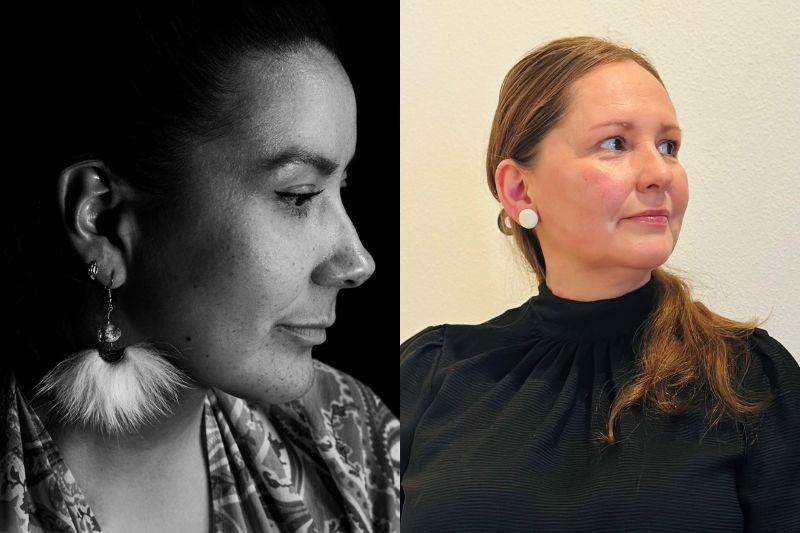
With Naja arferlu (“Naja and the whale”, not translated into English) Karline Nathansen and illustrator Pernille Kreutzmann-Larsen have created a poetic and sensuous picture book that gives a clear voice to an Arctic way of understanding the world. Through a child’s encounter with the sea and through relationships between generations, the book opens up a universe in which nature, storytelling, and community continue to shape ways of being in the world.
Karline Nathansen’s picture book Naja arferlu is a poetic and visually enchanting narrative that gives Greenland a distinct and recognisable voice in Arctic children’s literature – and thereby also in the Nordic literary conversation. At a time when the Arctic is often discussed in terms of strategic interests and global power relations, the book reminds us of something more fundamental: that the Arctic is first and foremost a lived landscape – a place where people, animals, and nature exist in deep and reciprocal relationships, and where storytelling is a way of understanding the world.
The story follows the girl Naja and her close relationship with her grandmother. In their time together, a space opens up in which imagination and reality flow into one another. When Naja encounters a whale and is taken on a dreamlike journey through the world of the sea, the reader enters a universe in which nature isn’t merely a backdrop but an active presence. The sea, the animals, and the landscape appear as part of a relational community in which humans don’t stand apart from nature, but are woven into it.
This understanding of the world is closely aligned with Arctic and Indigenous forms of knowledge, in which land, sea, and life are seen as interconnected. In Naja arferlu, this perspective is conveyed with remarkable ease through the child’s point of view. Naja’s encounter with the whale thus becomes not only a fantastical adventure, but a poetic experience of being in relation to the surrounding world – a world in which nature has its own presence and dignity.
At the same time, the book is a quiet and moving tribute to oral storytelling traditions. The relationship between Naja and her grandmother forms the warm centre of the narrative. It’s through conversation, storytelling, and shared presence that the world opens up to the child. Stories carry experience and knowledge across generations, but they also carry something more: a sense of belonging, care, and continuity. Here, the oral tradition appears not as a remnant of the past, but as a living way of being in the world.
In Naja arferlu, storytelling isn’t merely something that’s told; it becomes a way of being in the world – in relation to nature, to one another, and to the stories that connect generations. In this context, Naja arferlu also resonates quietly with the contemporary world in which many children grow up. In a day-to-day life shaped by constant digital presence, the book points towards the value of attention, imagination, and presence. It reminds us that the world can still be discovered through the senses, through relationships, and through storytelling – in encounters between people and in encounters with nature.
The illustrations by Pernille Kreutzmann-Larsen are central to the book’s artistic strength. In a vivid watercolour style, she creates a visual universe in which light, colour, and movement give the narrative an almost dreamlike quality. The depths of the sea, the Arctic landscapes, and the encounters between child and animal unfold in images that are both richly detailed and open to the reader’s own imagination. The interplay between text and image turns the work into a cohesive picture book in which the visual and linguistic layers enhance one another and create a unified artistic expression.
Karline Nathansen was born in Paamiut in 1979, the same year that home rule was introduced in Greenland. She grew up with her four siblings close to nature, spending many hours in the landscape surrounding her hometown. She is educated in sport and event management, and is a certified interpreter and translator in Greenlandic and Danish within the healthcare sector. Today she lives in Randers with her husband and their two children. There she works both as an interpreter for Greenlandic citizens and at the reception of Randers Art Museum. Karline Nathansen began writing in 2019, and in 2025 she published her first children’s book, Naja arferlu.
Pernille Kreutzmann-Larsen was born in Sisimiut in 1987 and is the youngest of several siblings. From an early age, she had many interests, including singing, drawing, painting, writing stories, songwriting, and handicrafts, all of which she was very passionate about. Her interest in history has always been an important part of her life, and she is therefore educated in cultural and social history from the University of Greenland. In the music world, she’s well known as a singer and songwriter in the band TIU. Since 2017, Pernille has worked as an illustrator on a number of books, including Tuttuarannguaq by Camilla Sommer, which was nominated for the 2019 Nordic Council Children and Young People’s Literature Prize. Today she works independently in art and music, and is also involved in running the publishing house Masaatsiaq as deputy director.