
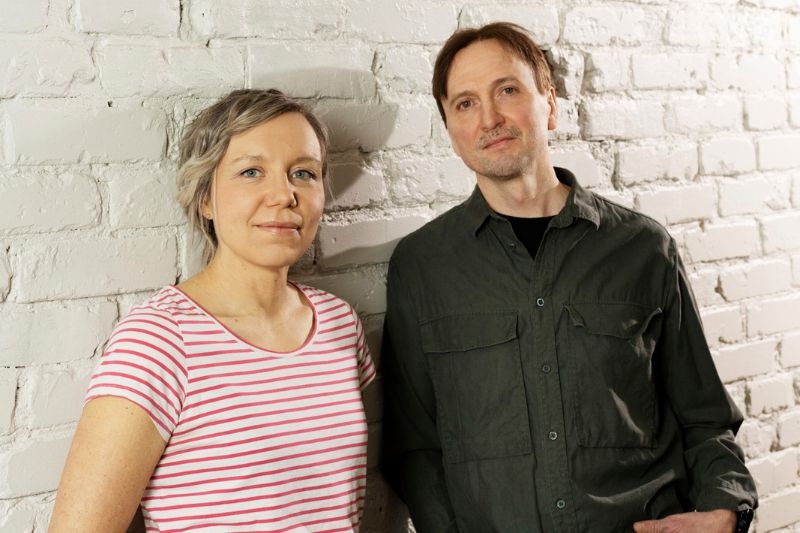
Tomi Kontio and Elina Warsta
The illustrated short novel Koira nimeltään Kissa hyvästelee ystävän (“A Dog Called Cat Says Farewell”, not translated into English) challenges many preconceptions about what a modern children’s book can be. It tells the story of a dog, a cat, and a human; of life on the outskirts of the harbour in a city called Helsinki; and of a spring forest where liverworts sway in the wind and ferns unfurl into eagle-like fronds. It’s a story about grief and death, about bidding farewell to the one who is dearest and most important to you.
The dog is called Cat, the cat is called Dog, and the human is called Mink, who also describes himself as a drunk. They live in an abandoned container, watching a TV that doesn’t work and inventing their own programmes, from sports commentary to soap operas. The main character and first-person narrator is the dog called Cat, who depicts the trio’s loving life together. Alongside melancholy and growing sorrow, the narrative contains humour and social criticism, primarily conveyed through the lines of the human, Mink.
Author Tomi Kontio dares to lead his readers towards one of the most difficult aspects of life: death. He trusts in poetic language and the inherent potential in a children’s book to address not only grief and marginalisation, but also love for one’s neighbour – using expressions that may allow even adult readers to perceive connections to, for example, the Sermon on the Mount. Yet the book neither presupposes nor imposes any particular religious worldview or interpretation. The philosopher and preacher of the story is Mink, a dying man of the streets and an alcoholic, who speaks at length and with eloquence, attempting to help his friends, the dog and the cat, to face what’s to come. The reader is also drawn into his metaphorical reflections and invited to contemplate grief and death in an unusually direct way. Equally central is the book’s other theme, love, which Mink describes as both the enabler of sorrow and its counterpart.
The conversations between Cat, Dog and Mink are thought-provoking, and on rereading the book, these reflections deepen and intensify, becoming even more moving and warming. The book succeeds in touching the reader, but also provokes laughter and is surprisingly direct and unvarnished. The language is beautiful, precise and resonant – both emotionally flowing and expansive, yet clear and lucid. Nature – decaying aspens and the birds of spring – is depicted exactly as it is, but also as part of the character’s experience: when a small bird sings in the forest, it clothes the protagonist in a coat of sorrow.
Halfway through the book, after Mink’s death, the narrative shifts into the survival story of Cat and Dog, and the storytelling takes on a more active mode. A city now also becomes present, which can literally be heard in the protagonist’s voice. When she is trapped behind bars and howls for help, the melody is “long and plaintive, like an underground train as it pulls into the depot”. The work concludes the story of the trio, whom the reader has been able to follow in several popular picture books prior to this final instalment in novel form. However, the book also functions as a standalone work and doesn’t require familiarity with the earlier volumes.
Elina Warsta’s skilful illustrations and layout form an integral part of the work and its strength. Her black-and-white full-page drawings filter both sorrow and comfort, light and shadow, sensitively and tenderly. Through a dense line technique, Warsta creates moments that are sometimes reassuring and sometimes unsettling, framing scenes in intriguing ways, or opening up space within a grove landscape or a nocturnal harbour view. The images also conceal various embrace-like compositions within this world. In addition to being held by a human or an animal, one may, in Warsta’s images, sit in the embrace of a forest, a room, or a starry sky.
As a reading experience, Koira nimeltään Kissa hyvästelee ystävän is a deeply affecting, even profoundly moving work, which also offers immense understanding and comfort. It’s a genuine, powerful, and important book that can be read not only by children and young people, but also by adults of all ages.
Tomi Kontio (b. 1966) is a poet and author who has twice received the Finlandia Prize for Children’s and Young People’s Literature: in 2000 for the children’s novel Keväällä isä sai siivet and in 2025 for the short novel Koira nimeltään Kissa hyvästelee ystävän. The first book in the series, the picture book Koira nimeltään Kissa, was nominated for the 2016 Nordic Council Children and Young People’s Literature Prize.
Elina Warsta (b. 1979) is one of Finland’s most well-known and respected illustrators and graphic designers. She was awarded the State Prize for Children’s Culture in 2016, and her illustrations have been nominated for several awards, including the Nordic Council Children and Young People’s Literature Prize for the picture book Koira nimeltään Kissa. Warsta also designed the layout of the book nominated in 2026.