Nordic-Baltic ministers take important step towards introducing digital identity wallets

Imagine that you live in the Nordic or Baltic region, but have studied in France and want to access your diploma digitally. Or that you work in Latvia and want to receive your payslip in a digital mailbox. Today, it is difficult to access digital services and documents across national borders. But the EU wants to change this – and by the end of next year, all countries must offer at least one secure and reliable digital identity wallet service that can be used throughout the region. The road to achieving this is not entirely easy and time is short, but through a recently adopted ministerial declaration, the Nordic and Baltic countries are joining forces to overcome the obstacles that exist.
The adoption of this declaration is an important step towards realizing our vision of making the Nordic region the world's most sustainable and integrated region. Close cooperation between the public and private sectors is crucial to ensuring that digital identity services are as functional and user-friendly as possible – for citizens, businesses, and public authorities alike.
Joint certification system
In the ministerial declaration, the Nordic and Baltic countries undertake to have their national authorities jointly develop a joint Nordic-Baltic certification system for digital wallets. The certification system will guarantee that digital wallets are secure and protect users' privacy and personal data. In addition, the countries will ensure common requirements that apply to the technical solutions and coordinate to reduce the administrative burden and increase cost-effectiveness.
Introducing digital identity wallets that work across national borders could revolutionize life for those of us living in the Nordic and Baltic countries, making it easier to travel, do business, and generally enjoy a less disruptive everyday life. Building on our long-standing cooperation and the regulatory framework already in place, we welcome discussions on how to continue our cooperation in the digital era.
An opportunity for the population registers
However, one obstacle to linking the various national digital identity wallets is the link to the population registers, which are national. If you are not registered in another country's population register, you cannot prove that you actually exist, and therefore cannot identify yourself digitally.
For these systems to communicate across borders, countries will need to introduce what is known as identity matching, i.e. matching a digital identity stored in one country with that of another. Back to the example above, when you log into to access your French diploma with your own national eID, the French system needs to connect your national eID to what is stored in the French system.
The Nordic and Baltic countries have a long and close tradition of cooperation between our population registries. Therefore, there is an opportunity to go one step beyond, and work towards increased data sharing between our population registries. Cooperation has already begun between Finland and Sweden, building on the well-established data-sharing between Finland and Estonia . At a meeting between the Nordic and Baltic ministers responsible for digitalization, where the declaration was also adopted, the issue of further expanding this cooperation to include more parts of the Nordic and Baltic regions was discussed.
Identity matching important step
The Nordic and Baltic countries are among the most digitally advanced societies in the world. We have a high level of confidence that digital tools are secure, reliable, and effective. The Nordic and Baltic ministers for digitalization want to maintain their position as leaders in public sector digitalization as part of their goal to become the world's most digitally integrated region by 2030.
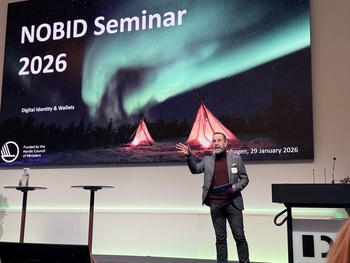
Important steps have already been taken through the Nordic-Baltic eID Project (NOBID) which is a collaborative project on eID funded by the Nordic Council of Ministers for Digitalisation. This year, NOBID developed a Proof of Concept for identity matching.
Identity matching is an important step towards preparing our countries for the introduction of European digital wallets next year. It is fantastic to see the Nordic-Baltic cooperation on digitalization, not least through the Nordic-Baltic eID Project, led by DigDir in Norway.
Declaration from the Nordic and Baltic Ministers of Digitalisation on promoting the adoption of the European Digital Identity Wallets in the Nordic-Baltic region
Adopted in Tampere, November 6, 2025
The Nordic and Baltic countries are among the most digitally advanced societies in the world. We have a strong reliance on electronic identification, digital trust services, and reliable population registries of high quality. We, the Nordic and Baltic Ministers of Digitalisation, are committed to ensuring that our region maintains its position as a leader in public sector digitalisation, and that the region becomes the most digitally integrated in the world by 2030.
Digital identity wallets are an important element in the digitalisation of the Nordic and Baltic regions. Close cooperation between the public and private sectors is essential to make digital identity wallets as functional as possible from the perspective of citizens, companies and public authorities.
The EU regulation on electronic identification and trust services (the eIDAS1 regulation) facilitates secure cross border transactions by establishing a framework for trust services and electronic identification. The revised regulation (the eIDAS2 regulation) entered into force on 20 May, 2024 and established a framework for digital identity and wallets. The regulation requires each EU Member State to ensure the availability of at least one certified European Digital Identity Wallet by 24 December, 2026. To pursue this goal, it is important that our region cooperates to produce a harmonised set of requirements and criteria for wallets offered in these Member States, enabling the creation of a competitive market of accredited conformity assessment bodies in the Nordics and Baltics.
The national authorities responsible for wallet certification will cooperate to produce and accept a common Nordic-Baltic certification scheme for European Digital Identity Wallets. By using a harmonised set of the requirements, we can strengthen the digital integration of the Nordic-Baltic region. The wallet certification ensures that the certified wallet solutions are safe, resilient, interoperable and follow the rules of privacy protection. The project for common certification criteria will conclude at the end of 2026, coinciding with the deadline for enforcing the revised eIDAS2 regulation at the national level in the EU Member States.
To enable this, we the Nordic and Baltic Ministers of Digitalisation will:
- Support building the prerequisites for a competitive single market of accredited conformity assessment bodies to promote cost-efficient delivery of certified wallet solutions in the Nordic and Baltic countries in order to pursue the timeframe required by the eIDAS2 regulation, taking into account the time of implementation in the EU and EEA EFTA states respectively.
- Ease the deployment of wallet solutions across the Nordics and Baltics by promoting a harmonised set of requirements to prevent fragmented and conflicting requirements for wallet providers.
- Call upon relevant actors to enhance coordination to avoid redundant work across Nordic and Baltic countries when setting up the wallet certification schemes. Having a common certification scheme ensures cost-efficiency and the reduction of administrative burdens among national competent authorities.
- Promote the role of Nordic and Baltic countries as pioneers of trustworthy digital identification means, widespread use of trust services, and cross-border interoperability. This also requires engaging closely with EU bodies and Member States beyond the Nordic and Baltic region.
This declaration builds upon the declaration of the Nordic and Baltic Ministers of Digitalisation on cross-border identity matching in the region adopted in Reykjavík on September 22, 2023.