Breathing new life into Nordic digital solutions
Although efforts to connect various digital services in the Nordics have been underway for some time, results have been slow to appear. In December 2021, the Nordic Council requested a status update on efforts to create a pan-Nordic electronic identification system (eID). The Nordic governments responded that it was not possible to implement such a solution at that time, the reason being that Iceland and Finland lacked both the necessary technical infrastructure to exchange cross-border logins and eID solutions that work in relation to eIDAS requirements.
Two years later, in September 2023, the Nordic Council Committee for Growth and Development in the Nordic Region received a new status update from the Nordic Council of Ministers, stating that the necessary technical solutions were due to be implemented in Iceland and Finland starting in the fourth quarter of 2023, i.e. a year ago. Norway’s representative in the Social Democrat Group, Truls Vasvik, describes the situation as follows:
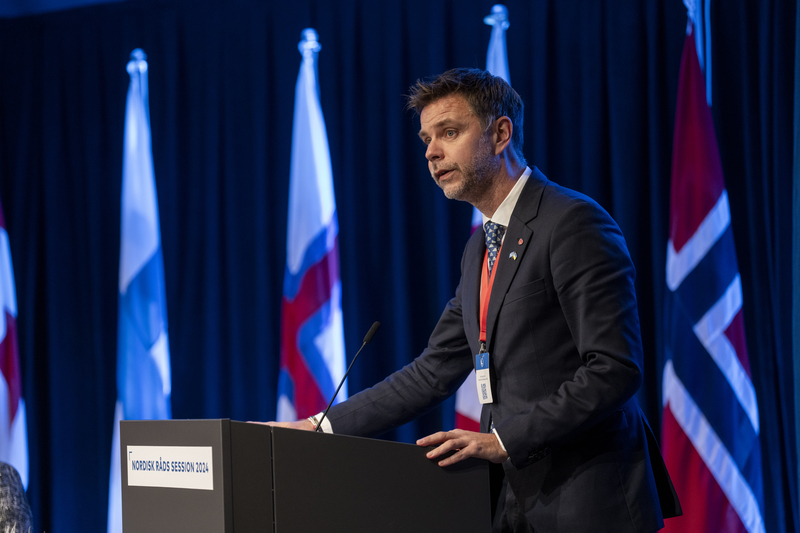
“It’s becoming a wasteland. The Nordics are losing the digital edge we once had. This has an impact on our competitiveness and creates unnecessary obstacles to freedom of movement for our citizens and businesses,” says Vasvik.
It’s becoming a wasteland. The Nordics are losing the digital edge we once had.
Impatient
This matter is a priority both for the Nordic Council Committee for Growth and Development in the Nordic Region and the Freedom of Movement Group. Vaksvik was therefore impatient when questioning the Ministers for Nordic Co-operation about the current status. It was Iceland’s Minister for Nordic Co-operation Willum Þór Þórsson who answered.
“Although I have to admit that I’m not completely up to speed on the matter, I do know that we’re working on digital development in all areas. From what I’ve read in the documents here at the meeting and the conversations we’ve had, we, like you, appreciate the importance of working as quickly as we can. I’m convinced that this is the key to efforts to remove obstacles to freedom of movement,” said Þórsson.
New times, new opportunities
Cross-border digital solutions or the lack thereof have posed a significant obstacle to freedom of movement in efforts to deliver on Vision 2030.
In line with the new programme for freedom of movement in the Nordic Region, the Ministers for Nordic Co-operation must regularly decide which major problem areas the authorities must work on in order to remove obstacles and anchor efforts at the national level. If the response from Iceland’s Minister for Nordic Co-operation was somewhat unclear, the Nordic prime ministers are much clearer. In a declaration adopted at their meeting in Reykjavik, they promise to take responsibility for stepping up co-operation on digital solutions across the Nordic Region. In the declaration, the prime ministers state that they will:
- Improve cross-border digital service infrastructures and the cohesion of relevant national infrastructures to support the free movement of people, goods, services, capital, and data in our region.
- Ensure that the responsible national authorities take the necessary measures to enable identity matching across national borders, in line with the revised eIDAS regulation.
- Identify and remove remaining obstacles, both legal and technical, to enable the exchange of information between business and population registers.
- Develop a multilateral agreement between our countries to improve the accuracy, flexibility, and security of cross-border identity matching of natural persons in our region, while adhering to existing and future EU regulations such as the establishment of the European Digital Identity Framework.
It’s pleasing to see the prime ministers clearly express responsibility and aspirations in respect of joint Nordic digital solutions.
Now that the Nordic prime ministers are taking a clear responsibility for the Nordic Region’s digital development, Truls Vasvik hopes that the wasteland will start to bear fruit.
“It’s pleasing to see the prime ministers clearly express responsibility and aspirations in respect of joint Nordic digital solutions. Since this requires cross-sectoral and cross-border co-operation, it’s vital that the prime ministers take the lead and get all relevant agencies to move in the same direction. We in the Nordic Council will follow things closely and act as constructive watchdogs and partners in the future,” concludes Vasvik.