Welfare Committee continues work to prevent intimate partner murders
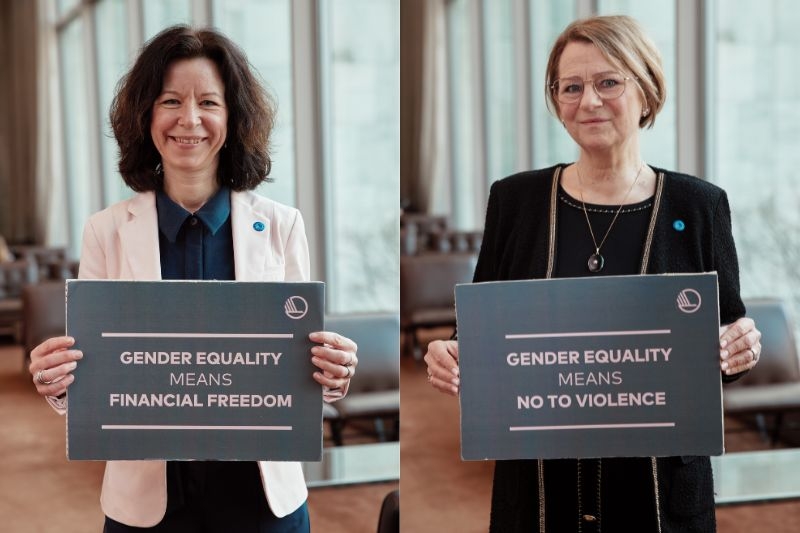
At the UN Commission on the Status of Women (CSW), the Nordic Council has been raising the serious issue of intimate partner violence and murder for several years. Pictured are the chair and vice-chair of the Nordic Council Welfare Committee, Eva Lindh (left) and Tone Wilhelmsen Trøen (right), at the 2024 CSW.
The grim statistics show that violence against women and intimate partner murders are serious problems in all of the Nordic countries, despite the region's high ranking on gender equality indices. For over two years, the Committee for Welfare in the Nordic Region has been striving to improve and coordinate efforts to prevent and combat the phenomenon.
The justice ministers will now follow up on the Nordic Council’s recommendation and launch initiatives that will make it possible to monitor and study intimate partner murders on a Nordic level.
“I am pleased that the work done by the Nordic Council has resonated with the ministers. I also look forward to following up on this announcement and making sure it results in greater Nordic efforts to combat intimate partner violence and murders,” says Tone Wilhelmsen Trøen, vice-chair of the Welfare Committee.
Sharing knowledge will help prevent and combat intimate partner murders
In late 2023, the Nordic Council recommended that the national governments should begin work on Nordic definitions and statistics for intimate partner murder in the region. The Nordic governments response at the time was that it would be impossible to introduce new definitions without disrupting the time series in existing national statistics.
“In this harrowing area, the Nordic countries are unfortunately similar. That’s why it makes sense to work together on common definitions, on better sharing of data, experiences and information. In particular, it makes sense that we all show stronger political will to act,” adds Trøen, who has followed the proposal since its inception.
The response from the governments spurred the Committee to request a more detailed description of the difficulties involved in drawing up definitions and compiling statistics in order to identify measures that could lead to comparable statistics. In April 2024, the Committee entered into a political dialogue with the ministers of justice on the matter.
Proposal to use the European Homicide Monitor
The political dialogue was continued by Finland’s Minister of Justice, Leena Meri, at the recent Nordic Council meetings in Oslo. The minister presented a proposal for following up on the Committee’s recommendation.
The proposal revolves around the use of the European Homicide Monitor (EHM). According to the minister, the EHM makes it possible to monitor and investigate intimate partner murders on a Nordic level without disrupting national statistics. This would allow the countries to keep compiling their own time series and provide a comparable knowledge base – as per the intention behind the Nordic Council’s recommendation.
The next step is that the Committee of Senior Officials /EK-JUST) to decide on a specific project funded by the Nordic Council of Ministers (MR-JUST) to look at 1) how using EHM might help achieve the goal of presenting an overview of intimate partner violence in the Nordic countries, and 2) the best way to use EHM.
I am pleased that the work done by the Nordic Council has resonated with the ministers. I also look forward to following up on this announcement and making sure it results in greater Nordic efforts to combat intimate partner violence and murders. Ultimately, this is about one of the most fundamental aspects of life: that your home should be a safe place. When it’s not, the problem runs deep – and when violence and fear end in murder, it is a tragedy that should never have happened.
Work goes on
The Committee followed up by asking the minister to set up a joint Nordic commission on intimate partner murders. The Minister had not yet discussed the proposal with the national governments, but intimated that she was positive about the idea.
The Committee will continue to monitor progress on the development of a joint Nordic EHM system and Meri’s positive reaction to the proposal for a Nordic commission.
“Murder is the most extreme consequence of violence in relationships. We owe it to the victims and their families to learn from every single case, and we believe that a joint Nordic commission on the issue will provide us with new knowledge and better preventative measures. We are very pleased that the minister responded positively to our proposal, and we will follow this up closely,”
Background
Work on the subject began in September 2022, when the Conservative Group submitted a member’s motion calling for joint Nordic efforts to improve knowledge of the issue and find better ways to prevent intimate partner murder. In 2023, as a result of the proposal, the Nordic Council submitted its recommendation for a Nordic definition and statistics to the national governments.
The response at the time was that it would not be possible, mainly because a Nordic definition would disrupt national time series and make it difficult to monitor trends over time. The Committee did not accept the explanation and initiated a political dialogue to obtain a more detailed response, which has now led to the ministers presenting an alternative proposal.
The proposal to use the European Homicide Monitor was put forward jointly by all of the Nordic countries. The justice ministers work together on the Nordic Council of Ministers (MR-JUST), and the Finnish minister represents all of them in the political dialogue with the Nordic Council.