Integration Through Digitalisation – Case CBDS-Study Project

For residents of the Nordics and Baltics, studying abroad should be as natural as pursuing education at home. Early international experiences foster a shared Nordic identity and build long-term networks.
Cross-border mobility has surged. A 2019 study by the Nordic Council of Ministers (NMR) reported a 60 % increase in cross-border employment between Sweden and Denmark from 2005–2015. Over 300,000 Nordic citizens live or work in another Nordic country, including 8,500 students. Despite temporary setbacks like the Covid-19 border closures, mobility trends are expected to grow.
The NMR’s vision is for the Nordics to be the world’s most integrated region by 2030. Achieving this requires seamless cross-border exchanges of personal data, such as educational credentials, despite varying national regulations.
Finland Takes the Initiative
Addressing this challenge, the NMR has embarked on a long-term key strategic journey financing several different projects promoting solutions for enhanced cross-border data communication and interoperability between local digital platforms and services. During their Nordic Council Presidency in 2021, Finland launched a programme concept entitled World’s Smoothest Cross-Border Mobility and Daily Life Through Digitalisation.
One of three major work packages within the Finnish Presidency programme was the Improved Cross-Border Digital Services for Studying Abroad in The Nordic and Baltic Countries Project, commonly abbreviated as CBDS-Study. The project came to focus on the very practical problem of secure international digital transfers of education credentials between universities and higher-education institutions (HEI).
The CBDS-Study project was delegated to the Finnish National Agency for Education (fi: opetushallitus, sv: utbildningsstyrelsen) and placed in the hands of Project Manager Riikka Rissanen and Specialist Petteri Pulli. The duo wrapped up their four years’ effort in December 2024.
“The outcomes of this project have supported students and study administration by promoting smoother and more secure interoperable digital services, particularly in harmonized student mobility processes. We also believe that the Baseline Study and Handbook of Cross-Border Data Exchange of Educational Credentials offer valuable knowledge bases for local authorities and related initiatives”, say Pulli and Rissanen.
”Citizens already expect it”
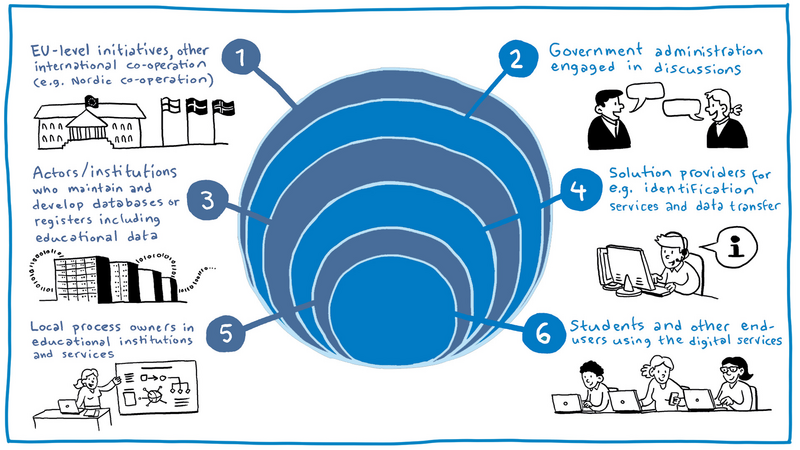
1. EU-Level Initiatives Co-Operation
CBDS-Study supported EU projects like Digital Credentials for Europe (DC4U) and the Once-Only Technical System (OOTS), promoting secure cross-border document exchanges.
2. Government Officials
The project engaged ministerial-level officials, especially in Finland, Estonia, and Latvia, fostering long-term commitment.
3. Database and Registry Professionals
Collaboration with national IT providers like Finland’s IT Centre for Science (CSC) helped enhance data interoperability. Says Kimmo Rautio from the CSC:
“The CBDS-Study project has worked with stakeholders responsible for developing current and new databases, services, and registries for study data. The project has been an influencer and driving force for all actors and activities. Their contribution has significantly supported the interoperability of study data between Baltic and Nordic higher educational institutions.”
4. Solution Providers
CBDS-Study expanded the use of the EMREX platform, facilitating international student data exchanges.
”The EMREX User Group and its Executive Committee is very pleased with the work done in the CBDS-Study project. They’ve been a great advocate for the EMREX-system and their work has resulted in tangible outcomes. There are now two new EMREX members with data sources and clients, which is a major accomplishment!”, says the chair of the EMREX User Group Committee, Tor Fridell, from Linköping University. He continues:
”Apart from that the project has delivered a well-written handbook for parties interested in joining the EMREX-network, which will be very useful for us. The EMREX Executive Committee sincerely thanks the project and especially its project management.”
5. Local Process Owners at Educational Institutions
The project promoted standardized administrative processes, boosting international compatibility.
6. Students
Ultimately, students benefit from streamlined credit transfers that reduce administrative stress and personal bureaucratic responsibility, encouraging more young people to study abroad.
The Path Forward, Project manager CBDS-Study Project
To fully realise a unified cross-border data ecosystem, the CBDS-Study project recommends ongoing research, stakeholder training, and policy alignment. They highlight the need for further analysis on the costs and benefits of expanding data exchange initiatives, particularly in areas like population data, which, going forward, would support additional digital services like identification, healthcare, and taxation data.
The project also recommends nations and supernational organisations to engage in the development of new international agreements to harmonise data sharing practices and address remaining legal ambiguities. These are essential for creating common, resilient data exchange systems that can withstand future challenges.
”By strengthening the network between authorities and other key stakeholders, our project has enabled a closer future collaboration of educational data exchange in the Nordic-Baltic area.”
As the initial phase of the CBDS-Study project ended in December 2024, its legacy is a commitment to a digitally cohesive and well-working future for residents in all the Nordic-Baltic region. It is the shared hope of everyone involved that this critical groundwork covering technical, legal, and organisational barriers—as well as solutions to remove them—will be of good use going forward. As the key players Rissanen and Pulli conclude:
”By strengthening the network between authorities and other key stakeholders, our project has enabled a closer future collaboration of educational data exchange in the Nordic-Baltic area.”
Sources, links, and further reading:
CBDS-Study Project Website
Improved Cross-Border Digital Services for Studying Abroad in The Nordic and Baltic Countries
https://wiki.eduuni.fi/pages/viewpage.action?pageId=395924184
Presentation of the CBDS-Study Project:
The Baseline Study of Cross-Border Data Exchange in the Nordic and Baltic Countries:
https://pub.norden.org/temanord2021-547/
The Handbook of Cross-Border Data Exchange:
https://pub.norden.org/temanord2023-542/
The Finnish Presidency Programme:
”World’s Smoothest Cross-Border Mobility and Daily Life Through Digitalisation”
https://wiki.dvv.fi/pages/viewpage.action?pageId=117377490
The Nordic Council of Ministers’ Cross Border Digital Services (CBDS) Strategic Initiative:
https://www.norden.org/en/project/cross-border-digital-services-cbds
EMREX Homepage