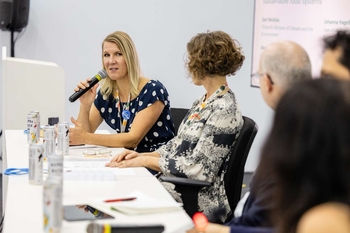
EXPO 2025: Equal opportunities are important for competitiveness
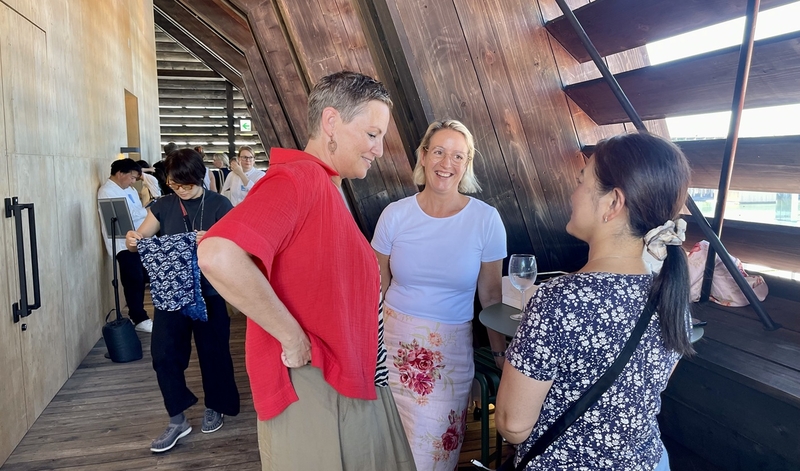
The Japanese-Nordic dialogue on equality continued in every corner of the Nordic pavilion: Ida Heimann Larsen, the Chief of Staff at the Nordic Council of Ministers, and Halla Nolsøe Poulsen, chair of the Faroe Islands Gender Equality Committee
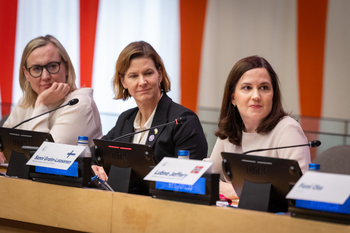
The Nordic Pavilion at EXPO 2025 in Osaka, Japan, has just hosted a Nordic Gender Equality Day. The programme was opened by Sirið Stenberg, Faroese Minister of Foreign Affairs, Industry and Trade, and Ida Heimann Larsen, the Chief of Staff at the Nordic Council of Ministers. In her speech, the Minister focused on the diplomatic initiative that Japan, Denmark, Finland, Iceland, Norway and Sweden embarked upon in 2024 as part of which equality work plays a key role.
Gender equality is a cornerstone of the recently agreed Japanese-Nordic diplomatic initiative. Nordic experiences with gender equality and Japanese experiences with innovation make a combination that can serve as an example to ourselves and on the global stage.
Equality in the labour market boosts competitiveness
Equality covers multiple policy areas, and one of those that is absolutely central to competitiveness is equality in the labour market, the Chief of Staff pointed out.
“When women and men participate on equal terms in the labour market and in the home, society becomes more innovative, inclusive and economically sustainable,” she said. She also emphasised that equality is crucial for economic growth and competitiveness. Several studies have shown that work teams consisting of both genders are more productive and better at addressing challenges. In Japan, the labour market is less equal than in the Nordic countries. in general, the Nordic Region and Japan are quite far apart when it comes to gender equality. According to the World Economic Forum's gender equality index, Japan ranks no. 118 out of 147, while the Nordic countries are at the top.
Progress is being made towards greater gender equality in Japan
Although Japan has not seen the same progress on gender equality as the Nordic countries, change is happening, according to Masahiro Kuniyuki, CEO of Mitsubishi UFJ Financial Group Inc. He welcomes Nordic initiatives for equal opportunities and is personally seeking to make the workforce in his company equal for several reasons.
“I have personally experienced that there are angles and nuances that I, as a man, don’t see, but that women do. So, it’s important to include both women’s and men’s perspectives when addressing challenges. It’s important from a professional perspective, but for me it’s also personal. I am the father of two girls and my wife’s husband. I very much want them to have the same opportunities as boys and men in Japan,” he said.
Maternity leave for both mothers and fathers
Halla Nolsøe Poulsen, Chair of the Faroe Islands’ Gender Equality Committee, pointed to another perspective that is crucial for a gender-equal labour market: fathers and sharing parental leave more equally.
“Women entering the world of work and men playing a growing role in family life have helped change our Nordic societies. These changes aren’t just good for women – they have also boosted our economies and made our welfare states more sustainable,” she said.